Israel and the PalestiniansThe White House, Washington
Oslo I – the Declaration of Principles
Interim agreementInterim arrangement still applying
A declaration of principles for an interim period of up to five years. It is not a final peace treaty, and not an agreement between two states.
In 30 seconds
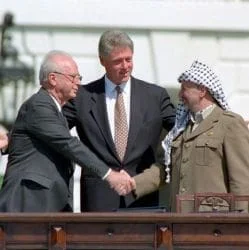
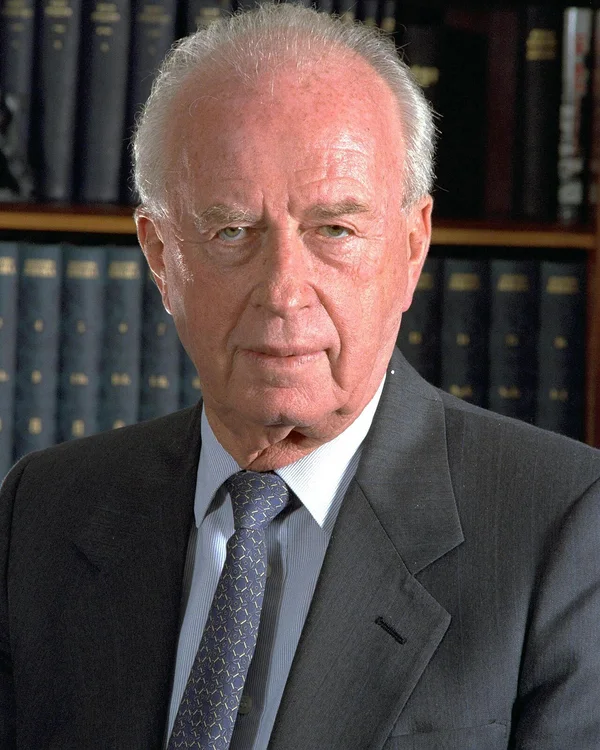
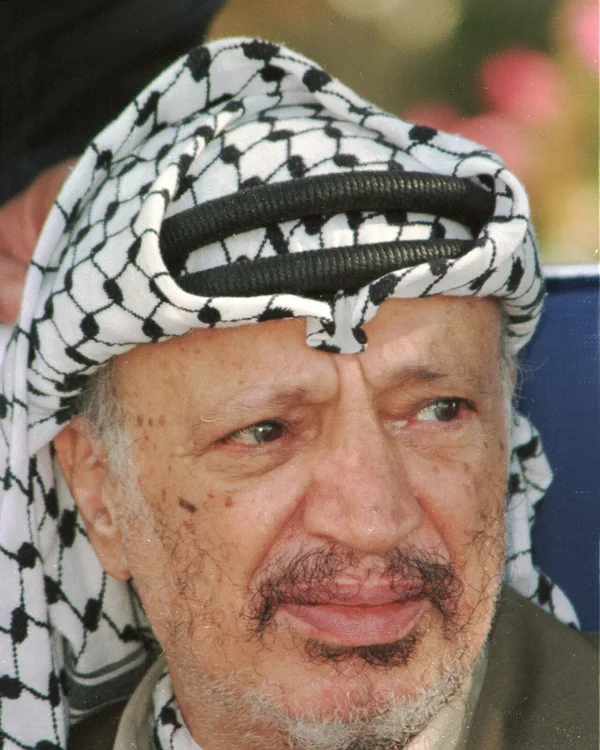
On 13 September 1993 the Declaration of Principles between Israel and the PLO was signed at the White House, in front of the world's cameras, in the presence of Yitzhak Rabin and Yasser Arafat.56 It set up temporary Palestinian self-government, starting in Gaza and Jericho, and left the hard questions for a permanent settlement.5
Where it stands today
The interim period was due to end on 4 May 1999,22 but no permanent settlement was reached, and the temporary arrangements go on operating by default. As of October 2026, the Security Council Report survey describes no permanent-status negotiations.24
To replace confrontation with step-by-step negotiation: temporary Palestinian self-government first, a permanent settlement after.
The challenge
In 1993 the talks that followed the Madrid Conference were stuck,1 and Israel and the PLO still did not recognise each other.2
Israel wanted security and recognition of its right to exist. The PLO wanted recognition as the representative of the Palestinian people and the beginning of the end of the Israeli occupation in the West Bank and Gaza. The first bridge was the letters of mutual recognition.2
The road there
Terje Rød-Larsen, head of the Norwegian research institute Fafo, proposes a secret channel, and the Norwegian foreign ministry backs it.3
Choose a country on the map or in the list. Use + and − to zoom. On touch screens, enable gestures to drag and pinch; scroll the page outside the map. Keyboard: arrows to pan, + and − to zoom, Home to reset.
Layers · Legend
International boundary agreed in a peace treaty
Treaty line with Jordan, “without prejudice to the status” of the territory beyond it
1949 armistice line (“Green Line”) — not an agreed final border
“Blue Line” — UN line of withdrawal (2000), not a border
Ceasefire / disengagement line with Syria (1974)
Other international boundary
West Bank and Gaza Strip: permanent status not agreed
Golan Heights: held by Israel since 1967; annexation not recognised by the UN
UN area of separation (UNDOF)
Classification follows the original research as of 7 Oct 2026. This schematic map is not a legal boundary map or a live update.
International boundary agreed in a peace treaty
Treaty line with Jordan, “without prejudice to the status” of the territory beyond it
1949 armistice line (“Green Line”) — not an agreed final border
“Blue Line” — UN line of withdrawal (2000), not a border
Ceasefire / disengagement line with Syria (1974)
Other international boundary
West Bank and Gaza Strip: permanent status not agreed
Golan Heights: held by Israel since 1967; annexation not recognised by the UN
UN area of separation (UNDOF)
Schematic map. Lines are approximate and are not a legal determination. Data: Natural Earth (public domain), 1:10m scale; line classification and place names by this site. Lines as of October 2026. Peace map
The hard decisions
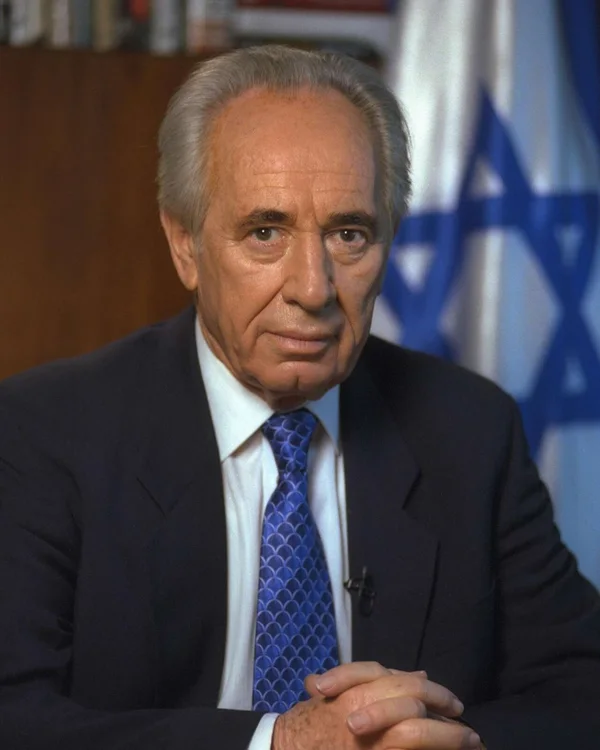
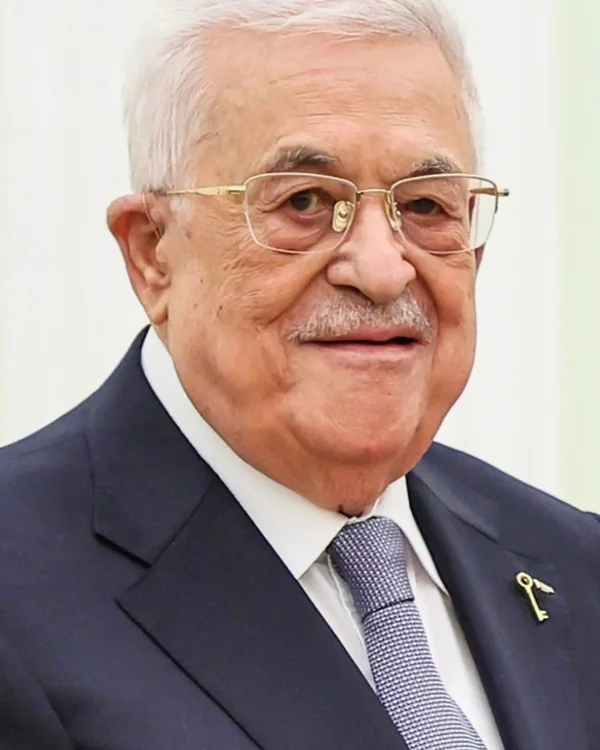
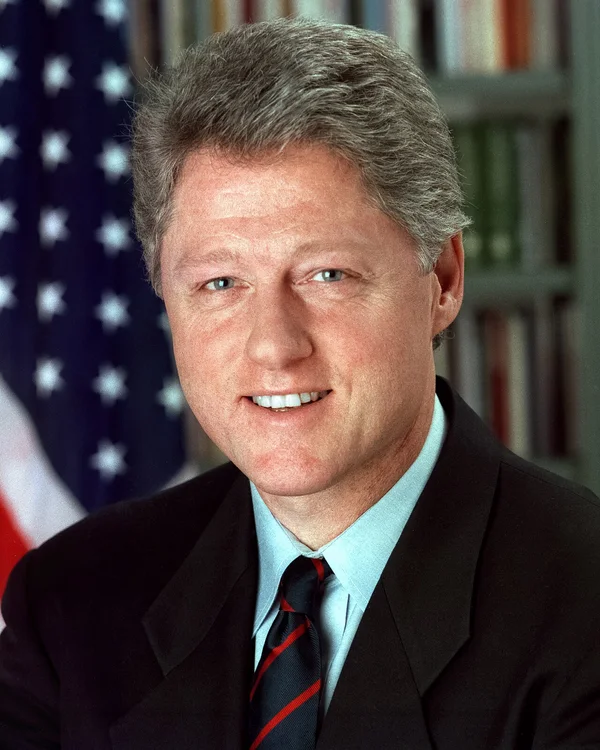
The document was signed by Foreign Minister Shimon Peres and Mahmoud Abbas; the witnesses were Warren Christopher and Russia's foreign minister Andrei Kozyrev.5 Rabin and Arafat, who led the move, attended the ceremony hosted by Bill Clinton.6
Opposition was fierce on both sides. The Knesset approved the Declaration by 61 votes to 50,6 and the follow-up agreement in 1995 by 61 to 59.7 Hamas rejected the negotiations and boycotted the 1996 elections.8
On 25 February 1994 Baruch Goldstein, a settler from Kiryat Arba and a follower of the Kach movement, carried out a terrorist massacre at the Ibrahimi Mosque / Cave of the Patriarchs in Hebron, murdering 29 Muslim worshippers.910 The talks stopped.11 Israel's government declared Kach and Kahane Chai terrorist organisations,10 and the army put Hebron's Palestinians under a curfew that lasted nearly two months.12
From April 1994 Hamas attackers murdered Israelis: according to the JTA list, eight people in Afula and five on a bus in Hadera that month. In February and March 1996 Hamas suicide bombers murdered 59 people in four attacks.13
Where accounts differ
According to Israeli critics of the accord
The accord did not bring security, and the Palestinian side did not keep its part. Likud and other opposition parties opposed the Declaration,14 and from April 1994 Hamas suicide bombers murdered dozens of people.13 Israeli governments said the Authority incited, released terrorists and did not collect illegal weapons.15 According to the historian Avi Shlaim, Benjamin Netanyahu opposed the accord in principle, because it recognised the PLO, accepted Palestinian self-government and began the partition of the land.16
According to Israeli supporters of the accord
The accord opened a way to peace without giving up security. Rabin presented it to the Knesset as the chance of a new era, stressing that Jerusalem and the settlements stayed under Israeli rule and security with the army.14Yossi Beilin, one of Oslo's architects, said in 2001 that Israelis expected an authority holding all the force not to let shooting start.17
According to Palestinian critics of the accord
The accord put off the essentials and did not stop the settlements. Hanan Ashrawi criticised it for not requiring Israel to stop settlement building and for postponing Jerusalem.16 Edward Said called it an instrument of Palestinian surrender,18 and the poet Mahmoud Darwish feared that Gaza and Jericho would be not only the first stage but also the last.16 Between September 1993 and July 2000 work began on 17,190 housing units in the settlements, according to Israel's Central Bureau of Statistics.19
According to Hamas and the rejectionist groups
Rejection of compromise with Israel as such.16 The day after the signing, the founder of Hamas, Sheikh Ahmed Yassin, said the Intifada would go on, and the PLO's opponents, Hamas first among them, stepped up their attacks.14 Hamas boycotted the 1996 elections.8
According to Researchers, and the Mitchell Committee (2001)
There is no single explanation. Khalil Shikaki: an open-ended agreement with no final goal, which large parts of both societies did not see as legitimate.17 Avi Shlaim: the framework was workable; in his view the PLO kept its side and Israel did not, and he faults Arafat for not making the talks conditional on a settlement freeze.16 The Mitchell Committee described clashing expectations: Palestinians expected the occupation to end within five years, Israelis expected a real fight against terrorism. It recommended both a freeze on settlement building and a full effort by the Authority to prevent attacks.15
What was carried out
In May 1994 the Gaza–Jericho Agreement was signed, Israel withdrew from most of the Strip and from the Jericho area, and the Palestinian Authority was set up.2021
Elections for the Palestinian Council and the head of the Authority were held on 20 January 1996, more than a year late.85
What was not
No permanent settlement was reached within the five years, which ended on 4 May 1999.22
What changed in real life
In May 1994 the Palestinian Authority was set up in Gaza and Jericho: for the first time a Palestinian body ran daily life.2021 In 1995 self-government was extended to the West Bank cities.23
The Paris Protocol tied the Palestinian economy to Israel's in currency, customs and taxes, and regulated Palestinian work in Israel.11
Israel imposed repeated closures: according to official Israeli figures compiled by B'Tselem, between December 1993 and November 2000 there were 326 days of full closure in the West Bank and 311 in the Strip.19 Israel's government presented them as security measures.15
The settlements grew: according to Israel's Central Bureau of Statistics, 115,700 settlers lived in the West Bank and Gaza at the end of 1993 and 176,973 in mid-1999, not counting East Jerusalem.19
What remains open
It is worth saying plainly: this is not a final peace treaty between two states. The Declaration was signed between a state and an organisation representing a people. It created no Palestinian state, fixed no border and did not end the conflict; it left the big questions for permanent status.5 What it did was open a road.
The Palestinian scholar Khalil Shikaki argued in 2001 that the problem lay in the structure itself: an open-ended agreement during which settlement building went on.17
The attempt to reach a permanent settlement at the Camp David summit in July 2000 ended without one.21
…we say to you today in a loud and a clear voice: enough of blood and tears. Enough.
Signing ceremony of the Israel–PLO Declaration of Principles, South Lawn of the White House, 13 September 1993
Source and status of the wording
Official White House transcript, in English. This is the end of a long sentence in which Rabin addresses the Palestinians, and the word that follows it; the opening of the sentence is omitted and marked with an ellipsis.
We have come to this point because we believe that peaceful coexistence and cooperation are the only means for reaching understanding and for realizing the hopes of the Palestinians and the Israelis.
Signing ceremony of the Israel–PLO Declaration of Principles, South Lawn of the White House, 13 September 1993
Source and status of the wording
The source is the English in the official White House transcript.
Arafat, Peres and Rabin receive the Nobel Peace Prize
· AP Archive
The prize was awarded to the three jointly for their efforts to create peace in the Middle East, following the Oslo accord. The decision was contested even then, and the Oslo process never matured into a permanent agreement.
The Price of Oslo, episode 1: Al Jazeera
· Al Jazeera English
The secret Oslo channel ran alongside the official talks in Washington and led to an agreement no one had expected.
The Price of Oslo, episode 2: Al Jazeera
· Al Jazeera English
The agreement raised great hope and sharp criticism on both sides, and what it gained and what it cost is still argued over.
The Israeli government's doubts before Oslo: archive records
· i24NEWS English
The decision was not easy in Jerusalem either: the records show the agreement was weighed and argued over inside the government itself.
President Clinton on the Declaration of Principles, 1993
· clintonlibrary42
The agreement was shaped in a secret channel in Norway, and the United States hosted the signing. It set out a gradual process, not a permanent settlement.
The Oslo signing: Yasser Arafat Foundation
· Yasser Arafat Foundation
Shimon Peres and Mahmoud Abbas signed, and Rabin and Arafat shook hands before the world: the first formal ceremony in which the two sides recognised each other.
The Washington signing on French television
· INA Histoire
Days earlier Israel and the PLO had exchanged letters of mutual recognition. The Rabin–Arafat handshake became one of the best-known images of the century.
Peres's Nobel Peace Prize acceptance speech
· Peres
The prize honoured all three for their efforts for peace in the Middle East, and Peres used the moment to sketch a vision of a cooperative region.
Signing of the Israel–PLO Declaration of Principles
· clintonlibrary42
Signing ceremony of the Israel–PLO Declaration of Principles, the White House, 13 September 1993 – Clinton Presidential Library channel
Sources
You do not have to agree with us. That is what the sources are for: open them, compare and check for yourself.