Borders, security, Jerusalem and refugees: how can the right to live in dignity become a workable agreement? As of October 2026, there is no final-status agreement or negotiation on one.1 There are proposals to compare and examine.
9 min read
Where we start
Our starting point is Israel’s right to exist as an independent, sovereign state in security, the Palestinian people’s right to an independent, sovereign state, and a life of security and dignity for both peoples. The proposals below try to translate those principles into borders, security arrangements, a status for Jerusalem and answers for refugees.
Different people and institutions stand behind these proposals. The Clinton Parameters came from a US president; the Arab Peace Initiative was adopted at an Arab summit; the Geneva Initiative was drafted by Israelis and Palestinians who did not represent their governments. Alongside the proposed terms, that raises practical questions: who can make a commitment, who must approve it, and who would carry it out?
Even Oslo left the hardest questions open. The 1993 Declaration of Principles put off Jerusalem, refugees, settlements, security and borders to permanent-status talks,2 and those talks have never been finished. People on both sides kept trying; their story is on the page Efforts that did not ripen.
Look closely
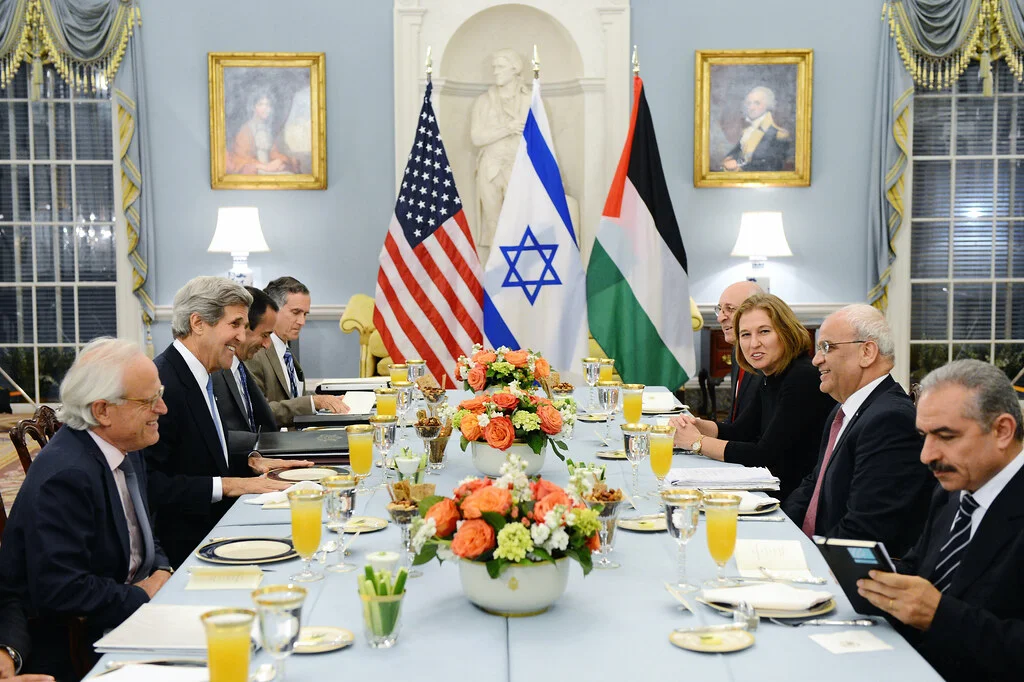
Who is around the table?
State Department photo / Public Domain · United States government work; caption: [State Department photo/ Public Domain] · Source and details
Livni, Erekat and Kerry at a State Department iftar in Washington, 29 July 2013, as talks opened.
What could turn a meeting between representatives into commitments that can be implemented and checked?
“
A voice from the archive
We have reached the age where dialogue is really the only way to run the world.
Open one topic at a time, or read them all in sequence. Each topic contains its full explanation and sources.
01One small land, two peoples
Most proposals start from the 1967 lines with land swaps, but the scale varies widely. The Clinton Parameters spoke of a Palestinian state on 94% to 96% of the West Bank.3 The Trump plan spoke of Israeli sovereignty over about 30% of it.4
02Security and fear
In 2001 the Mitchell committee described two fears. Israelis fear terror and doubt they can live side by side. Palestinians experience the occupation, the army and the settlements as daily humiliation.5 So many proposals pair a non-militarised Palestinian state with an international force.3
03Jerusalem
Both sides see Jerusalem as their capital, and the Old City is holy to more than one faith. Even the Clinton Parameters offered not one formula for the Temple Mount / Haram al-Sharif, but two.3
04Settlements
The Mitchell committee and the Roadmap called for a settlement freeze, and Sharon's government had reservations.56 Evacuation is painful: in the 2005 disengagement Israel removed about 8,500 settlers from the Gaza Strip.7 As of October 2026, building in the E1 area east of Jerusalem is still disputed.1
05Refugees
The Arab Peace Initiative asks for a just and agreed solution in line with UN Resolution 194.8 The Clinton Parameters offered five possible destinations for refugees, among them the Palestinian state.3 The Trump plan ruled out return to Israel.4 The gap is still open.
06Distrust
In a 2020 joint poll by Palestinian and Israeli researchers, 90% of Palestinians and 79% of Israeli Jews said the other side cannot be trusted. Fewer than one in five on each side believed the other side wants peace.9
07Who decides, and for whom?
In June 2007 Hamas, a terrorist organisation, took control of the Gaza Strip, and Palestinian rule has been split between Gaza and the West Bank ever since.10 In Israel, too, decisions are close: the Interim Agreement passed the Knesset in 1995 by 61 votes to 59,11 and in July 2024 the Knesset voted 68 to 9 against a Palestinian state.12
08One side has a state, the other does not
The power gap is wide. In July 2024 the International Court of Justice found, in an advisory opinion that is not binding, that Israel's continued presence in the occupied Palestinian territory is unlawful.13 According to the researchers Shira Efron and Evan Gottesman, income in Israel is roughly 30 times higher than on the Palestinian side.14
09Violence against agreements
Yitzhak Rabin was assassinated in 1995 by an Israeli who opposed the Oslo process.15 According to the US State Department's Office of the Historian, the Hamas bombings that followed wore down support for the government leading the process.16 On 7 October 2023 Hamas led a terrorist attack in which civilians were murdered and hostages taken, and the war in Gaza followed.17 Each blow like this hurts people first, and then trust.
What can build trust?
Open one topic at a time, or read them all in sequence. Each topic contains its full explanation and sources.
01Something real for each public
Egypt regained Sinai; Israel gained recognition and an end to the state of war. The treaty linked withdrawal to changes in relations: ambassadors, trade and ties between institutions.18 Peace took practical form even while the two publics remained distant. The Taba dispute was settled separately through arbitration, and the territory was returned in 1989.19
In the sources: stages and checks
The treaty with Egypt tied changes on the ground to changes in relations. Egypt regained Sinai; Israel gained recognition and an end to the state of war. Withdrawal was completed in April 1982, while the Taba dispute went to arbitration and the territory was returned in 1989.1819 Annex III set out the practical steps: ambassadors and an end to economic boycotts upon the interim withdrawal, followed by negotiations on trade and cultural arrangements. A political commitment could acquire a working address: an embassy, a commercial transaction, a link between institutions. Each undertaking can be checked separately against the document, even when the two publics remain distant.18
02Step by step, with someone checking
Trust need not mean taking a promise on faith. The treaty with Egypt set stages and a timetable for withdrawal; the MFO observer force conducts patrols and checks on the security arrangements.1820 That provides a way to investigate a suspected breach without starting the conversation again. The Roadmap also proposed progress tied to performance, but did not achieve its intended settlement.6
In the sources: stages and checks
The treaty with Egypt set two withdrawal milestones: an interim withdrawal within nine months of exchanging ratification instruments, and final withdrawal within three years.18 Monitoring has its own routine. The MFO describes patrols, observation posts and checks at least twice monthly unless the parties agree otherwise, with an additional check within 48 hours of either party’s request.20 A pledge thus gains a timetable and a way to investigate a suspected breach beyond conversations between leaders. The Roadmap also proposed progress tied to performance, but did not produce its intended settlement.6
03Protecting civilians
The 2001 Mitchell Report translated civilian protection into distinct, explicit demands. It called on the Palestinian Authority to prevent terrorism, arrest perpetrators and stop firing from Palestinian populated areas; it asked Israel to adopt non-lethal responses to unarmed demonstrators, lift closures and transfer tax revenues owed to the Authority.5 Distinguishing an unarmed demonstrator from a terrorist attacker is central to those recommendations. The report addresses what governments and security forces should do to reduce everyday danger before borders and permanent-status questions are settled.
04No facts on the ground in the meantime
For the Mitchell committee and the Roadmap, a settlement freeze and an end to violence were meant to leave the decisions to the table.56 The statement that closed the Camp David summit in 2000 also called for avoiding unilateral steps.21
05A leader who speaks to the other side's public
Sadat arrived in Israel on 19 November 1977 and addressed the Knesset the following day.2223 He offered Israelis a life in security beside their Arab neighbours, while demanding withdrawal from territories occupied in 1967 and a solution to the Palestinian question.23 The Jerusalem visit gave the disagreement a face and a voice: the president of a country Israel had fought addressed its elected representatives, letting them hear his offer and demands directly. Less than a year and a half later, the two countries signed their peace treaty.18
06People who meet
ALLMEP, a coalition of more than 200 Israeli and Palestinian organisations, says studies show that encounters change attitudes, but they have never been funded on a scale that changes whole societies.24 Groups working on the ground include the Parents Circle – Families Forum,25 Women Wage Peace and Women of the Sun,2627 and Combatants for Peace.28
07A shared need: water, the economy
Since 1994 EcoPeace Middle East has brought Jordanian, Palestinian and Israeli environmentalists together around water, the Jordan River and the Dead Sea.29 The 2025 New York Declaration calls for a review of the Paris Protocol and the release of withheld tax revenues.30
08Education against dehumanisation
The Mitchell committee called on both sides to denounce incitement and act against it,5 and the 1998 Wye River Memorandum included such a commitment.31 In the bilingual Hand in Hand schools more than 2,000 Jewish and Arab pupils learn together.32
The proposals in brief: who, what, for and against
a Palestinian state on 94% to 96% of the West Bank, and Jerusalem divided by neighbourhoods.3
For
the White House said both sides accepted them with reservations, and called that a step forward.33
Against
the Palestinian negotiating team wrote that they secured neither a viable state nor the refugees' return;34 the White House did not spell out Israel's reservations.33
The Arab Peace Initiative, 2002
Who
the Arab League, on a Saudi proposal, March 2002.
What
full withdrawal to the 1967 lines, a Palestinian state and an agreed solution for refugees, in return for normal relations with all Arab states.8
For
Marwan Muasher, who helped draft it, describes a collective peace with all Arab states and an end to all claims.35
Against
according to the Washington Institute, Israel objected to the reference to Resolution 194 and to the demand for full withdrawal on all fronts.36
Israeli sovereignty over about 30% of the West Bank and a demilitarised Palestinian state, with conditions. The Palestinians had no part in drafting it.4
For
the US ambassador to the UN called it realistic and implementable, and Israel's ambassador called it a sane new approach.44
Against
Abbas said it legitimises settlements and annexation and leaves Palestine fragmented.44
The New York Declaration, 2025
Who
a conference co-chaired by France and Saudi Arabia; the General Assembly endorsed it on 12 September 2025 by 142 votes to 10.45
What
time-bound steps to a Palestinian state alongside Israel, with Hamas handing over its weapons and leaving power in Gaza.45
For
according to France, it condemns the 7 October attack and offers a path to security for both peoples.46
Against
Israel rejected it, saying it ignores Hamas's responsibility;47 the United States called it a “gift to Hamas”.48
Confederation ideas
Who
the movement A Land for All, and the Holy Land Confederation proposal by Hiba Husseini and Yossi Beilin (2022).
What
two independent states with an open border and shared institutions.4950
For
its authors say it eases the way to two states without a mass evacuation.50
Against
according to Efron and Gottesman, an open border clashes with Israel's security doctrine, and the power gap remains.14
The same questions, different proposals. Start with each proposal’s standing, then examine borders, Jerusalem, refugees and security. The comparison opens with five proposals from different authors and periods. This is an editorial selection, not a ranking; you can change the selection.
Choose up to five proposals. Focus on the four core topics, open all topics, or examine one at a time.
5 proposals · 4 topics
Before the details: where does each proposal stand?
2000 · Official process
The Clinton Parameters
An official US bridging proposal delivered orally. The White House reported on 3 January 2001 that both sides accepted it with reservations; no signed agreement resulted
US President Bill Clinton; presented to Israeli and Palestinian negotiators on 23 December 2000
White House: 3 January 2001 briefing· Contemporaneous US statementSource location: Opening answer by Jake Siewert, followed by questions on reservations and their relative weight
An official US proposal; the Palestinian leadership rejected it, and it was not implemented
The administration of US President Donald Trump; presented on 28 January 2020 alongside Prime Minister Benjamin Netanyahu, without Palestinian participation
An official international declaration that is not binding; Israel and the United States voted against it. It is not an agreement between the parties
An international conference co-chaired by France and Saudi Arabia, July 2025; the UN General Assembly endorsed the declaration on 12 September 2025 by 142 votes to 10
A Palestinian state on 94–96% of the West Bank; a 1–3% land swap to compensate for annexation, alongside arrangements such as permanent safe passage. The map should ensure territorial contiguity.
Clinton Parameters: reconstructed text· Reconstruction of an oral proposalSource location: “Territory”, first three paragraphs and four mapping criteria
Arab Peace Initiative
Full Israeli withdrawal from the territories occupied in 1967, including the Golan Heights to the line of 4 June 1967 and the remaining territory in southern Lebanon. An independent, sovereign Palestinian state in the West Bank and the Gaza Strip.
A border based on the lines of 4 June 1967, with reciprocal 1:1 modifications shown on an attached map. A corridor between the West Bank and the Gaza Strip, under Israeli sovereignty and Palestinian administration.
Geneva Initiative: full text· Unofficial model agreementSource location: Article 4/1, 4/5 and 4/6; PDF pages 3–5
The Trump plan (Peace to Prosperity)
Israeli sovereignty over about 30% of the West Bank, including the Jordan Valley (the figure is from a Congressional Research Service summary; the text gives none). A Palestinian state in the rest, in non-contiguous areas linked by roads, bridges and tunnels; according to the plan, swaps would make it comparable in size to the pre-1967 West Bank and Gaza.
Two sovereign, democratic states within secure and recognised borders based on the 1967 lines, including with regard to Jerusalem. The Gaza Strip is part of the Palestinian state and is to be unified with the West Bank; the declaration rejects any reduction of the territory.
Arab neighbourhoods to Palestine and Jewish ones to Israel, including the Old City. Both alternatives place Haram al-Sharif / Temple Mount under Palestinian sovereignty and the Western Wall under Israel’s; formulations on religious claims and excavation differ, with international monitoring.
Clinton Parameters: reconstructed text· Reconstruction of an oral proposalSource location: “Jerusalem”, general principle and alternative formulations 1–2
Arab Peace Initiative
East Jerusalem as the capital of the Palestinian state. The holy places are not mentioned.
Capital of both states, with sovereignty divided by neighbourhood. The Temple Mount / Haram al-Sharif under Palestinian sovereignty with an international presence; the Western Wall under Israeli sovereignty; free movement within the Old City.
Geneva Initiative: full text· Unofficial model agreementSource location: Article 6/2–6 and 6/7(iii–v); PDF pages 10–12
The Trump plan (Peace to Prosperity)
Jerusalem stays undivided and under Israeli sovereignty. A Palestinian capital east and north of what the plan calls the security barrier, including Kafr Aqab, the eastern part of Shuafat and Abu Dis. The status quo at the holy places is kept.
The 1967 lines apply with regard to Jerusalem as well. The historic and legal status quo at the Muslim and Christian holy places is to be preserved, and the role of the Hashemite custodianship is acknowledged.
Return to Palestine and land transferred to it; admission in Israel, host states and third countries depends on their policies. An international commission handles compensation and rehabilitation; the agreement would implement Resolution 194.
Clinton Parameters: reconstructed text· Reconstruction of an oral proposalSource location: “Refugees”, five possible homes and paragraph immediately following them; final sentence on Resolution 194
Arab Peace Initiative
A just and agreed solution to the Palestinian refugee problem in accordance with General Assembly Resolution 194. The initiative rejects any resettlement of refugees that conflicts with the special circumstances of the host countries.
Compensation and residence choices: Palestine and swapped land are open to all refugees under Palestinian law; Israel, third countries and host states decide admissions sovereignly. An international commission administers the process; UNRWA ends five years after the commission starts.
Geneva Initiative: full text· Unofficial model agreementSource location: Article 7/3–4 and 7/13; PDF pages 15 and 19
The Trump plan (Peace to Prosperity)
No return to Israel. Three options: absorption in the Palestinian state within limits, integration in the host countries, or resettlement in member states of the Organisation of Islamic Cooperation, up to 5,000 a year for ten years. Compensation through a trust fund.
A just solution to the refugee problem in accordance with Resolution 194, a reaffirmation of the right of return, and support for UNRWA's continued work until a solution is found.
A non-militarised Palestinian state with strong security forces and an international force. An additional 36-month Israeli Jordan Valley presence under that force, plus three early-warning stations with ten-yearly review.
Clinton Parameters: reconstructed text· Reconstruction of an oral proposalSource location: “Security”, international presence, Jordan Valley, early-warning stations, and final two paragraphs
Arab Peace Initiative
In general terms only: the Arab states would sign peace agreements with Israel and provide security for all states of the region. No security arrangements are spelled out.
A non-militarised Palestine with a strong security force and multinational force. Israeli withdrawal within 30 months; a small Jordan Valley presence for 36 more months. The two early-warning stations have separate review after ten years, then every five years. A joint security committee with the United States addresses terrorism.
Geneva Initiative: full text· Unofficial model agreementSource location: Article 5/3(ii), 5/4(iv), 5/6, 5/7(v–vi), 5/8(i,vi–vii); PDF pages 6–8
The Trump plan (Peace to Prosperity)
Israel keeps overriding security responsibility west of the Jordan River and control of the airspace. The Palestinian state is fully demilitarised, and Hamas is required to disarm.
Hamas ends its rule in Gaza and hands its weapons to the Palestinian Authority. A temporary international stabilisation mission mandated by the Security Council, and security guarantees for Israel and Palestine. The declaration notes Abbas's statement that Palestine does not intend to be a militarised state, and condemns the Hamas-led terrorist attack of 7 October 2023 and the attacks on civilians in Gaza.
We can discuss peace while disagreeing. Start with what the sources show, and distinguish a proposal, progress and an agreement.
Are these five peace agreements?
No. Camp David and Taba were talks without a permanent settlement; the Parameters were an oral US proposal; the Roadmap was an international plan; Geneva is an unofficial model. A joint statement or support for a plan does not approve every detail.
Camp David closing statement· Official joint statementSource location: Opening paragraph; release date; principles 1–5
White House: 3 January 2001 briefing· Contemporaneous US statementSource location: Opening answer by Jake Siewert, followed by questions on reservations and their relative weight
ECF: Geneva Initiative background· Research and backgroundSource location: Date field; opening paragraph; final substantive paragraph
Where did positions converge on borders and Jerusalem?
Taba’s account records a 1967-lines and land-swap basis, alongside the neighbourhood principle for Jerusalem. Maps, swap proportions and holy sites remained disputed. That is progress worth learning from, without treating it as a completed agreement.
Does refugee “choice” mean unconditional entry to any state?
Not in the Clinton Parameters or Geneva model: residence in Palestine and swapped land differs from admission to Israel and other states, which they control. Taba left disagreements on return and numbers. Compare rights, options and admission conditions separately.
Clinton Parameters: reconstructed text· Reconstruction of an oral proposalSource location: “Refugees”, five possible homes and paragraph immediately following them; final sentence on Resolution 194
Geneva Initiative: full text· Unofficial model agreementSource location: Article 7/3–4 and 7/13; PDF pages 15 and 19
Ask who acts, who verifies and what happens in a dispute. Geneva specifies a multinational force and timetables; the Roadmap links progress to performance and oversight. These are tools for practical discussion. Trust, agreement and the ability to implement still have to be built.
Geneva Initiative: full text· Unofficial model agreementSource location: Article 5/3(ii), 5/4(iv), 5/6, 5/7(v–vi), 5/8(i,vi–vii); PDF pages 6–8
Geneva Initiative: full text· Unofficial model agreementSource location: Articles 1–3, 4/6, 9, 12–13, 16; PDF pages 1–5 and 19–22
Roadmap: Quartet text· Official Quartet planSource location: Preamble last paragraph; Phase I monitoring paragraph; Phase II and III opening paragraphs
Civil society: who is already working on it
Women Wage Peace
A movement born in 2014, after that summer's war in Gaza, which calls itself Israel's largest grassroots peace movement, with more than 44,000 members. It works for a political agreement made with women at the table, and its website has a Hebrew study page on the region's peace agreements.
An independent Palestinian women's association founded in July 2021 that strengthens Palestinian women in the economy, politics and leadership. According to the Georgetown Institute for Women, Peace and Security, it promotes the Mothers' Call with Women Wage Peace, and both have been nominated for the Nobel Peace Prize.
A joint organisation of more than 800 bereaved Israelis and Palestinians, founded in 1995. It runs dialogue meetings, education programmes and a yearly joint memorial ceremony.
An organisation founded in 1994 that brings together Jordanian, Palestinian and Israeli environmentalists, with offices in Amman, Ramallah and Tel Aviv. It works on water security and cooperation around the Jordan River and the Dead Sea.
A grassroots movement that calls itself the largest Jewish–Arab movement in Israel. It organises Jewish and Palestinian citizens for peace and an end to the occupation, equality and social justice, in local branches and on campuses.
A grassroots movement of Israelis and Palestinians founded in 2006 by former fighters from both sides, committed to non-violence. It co-organises the joint Israeli–Palestinian Memorial Day ceremony.
Hand in Hand: Center for Jewish-Arab Education in Israel
A network of bilingual schools where Jewish and Arab children, citizens of Israel, learn together. Launched in 1997, it opened in 1998 with 50 children; today more than 2,000 pupils attend its six schools.
A coalition of more than 200 Israeli and Palestinian peacebuilding organisations, founded in 2006 and based in Washington. It pushes for international funding of encounters and cooperation between people, including an International Fund for Israeli–Palestinian Peace.
Further reading: ideas, society and democracy in Israel
Two resources for exploring Israeli society and the civic context of shared life. These are platforms for viewpoints and public advocacy, rather than neutral historical evidence or peacebuilding organisations. Links imply neither a partnership nor agreement with every position.
Telem
A journal and ideas platform from the Berl Katznelson Foundation, covering politics, society, policy and democracy from a declared ideological perspective.51 Its writing can broaden discussion of Israeli society and political possibilities, while keeping interpretation distinct from historical documents.
A nonpartisan civic movement working to change policy on religion–state relations and promote freedom of choice and equality.52 Its relevance here is shared life and democratic society in Israel; it is not an initiative for a diplomatic agreement.
A document shows what was written; testimony tells what someone saw or remembers; research and reporting add interpretation and comparison. Always ask who produced the information and what still needs checking. The label alone does not establish quality, and two sites copying one document still give you one source.