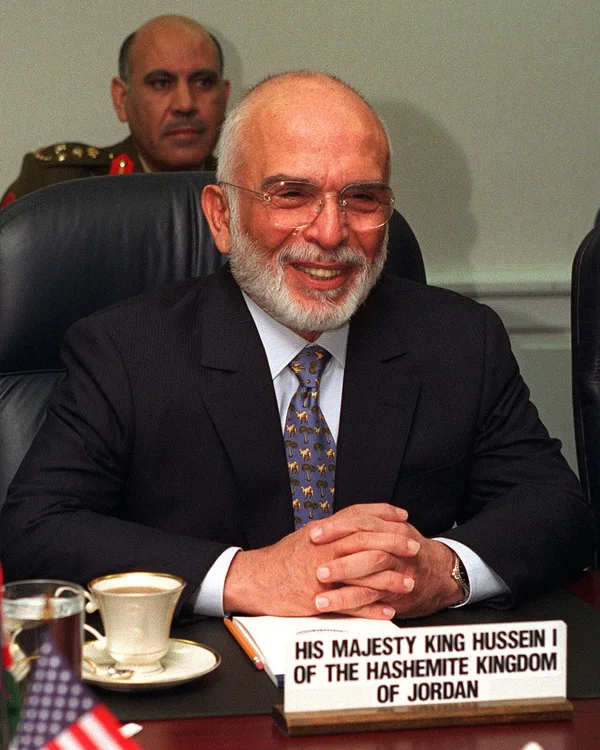
Israel and JordanThe Arava crossing, between Eilat and Aqaba
Israel–Jordan Peace Treaty
Peace treatyIn force, relations strained
A full peace treaty between two states, Israel's second with an Arab state. It does not determine the status of the West Bank.
In 30 seconds
On 26 October 1994, in the Arava desert, Israel and Jordan signed their peace treaty. It was signed by Prime Minister Yitzhak Rabin and Jordan's Prime Minister Abdul Salam Majali, led by King Hussein and in the presence of President Clinton.6 It is still in force, but political relations are very tense.19
Where it stands today
As of October 2026 the treaty is in force, and security coordination and the water supply it provides for continue.17 Political relations are at a low: Israel has had no ambassador in Amman since October 2023, Jordan recalled its ambassador in November 2023, and a royal decree reported in early July 2026 ended his mission without naming a successor.1917
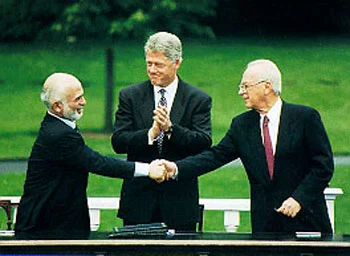
Hussein, Clinton and Rabin in Washington, 25 July 1994, ahead of the October peace treatyWhite HouseThe file we hold is small, so the photograph is shown at its true size rather than enlarged.
In one sentence
To turn decades of secret meetings into open peace: an agreed border, shared water and full relations.
The challenge
This peace was not born in a day. King Hussein had been meeting Israelis in secret since the 1960s, and according to the journalist Moshe Zak those meetings added up to more than seven hundred hours of conversation.1 On 25 September 1973, eleven days before the Yom Kippur War, he sat across from Golda Meir and warned her that war was coming.2 Beside her sat Mordechai Gazit, director-general of the prime minister's office, who according to his memorial site took down the conversation.32
In 1975 Hussein met Prime Minister Rabin in secret,4 and in 1987 he reached the London Agreement with Shimon Peres, which Israel's government did not adopt.5 None of these attempts succeeded, but each kept a channel open.
Jordan needed water, an agreed border and recognition of its role in Jerusalem; Israel wanted a quiet eastern border and a neighbour outside any hostile alliance. After the Oslo agreement the two could move in the open. The negotiators were Elyakim Rubinstein, Efraim Halevy and Peres for Israel, and Fayez Tarawneh and Prince Hassan for Jordan.4
The road there
At a secret meeting, Hussein warns Golda Meir that Egypt and Syria are preparing for war.23
A secret meeting between Hussein and Rabin, in Rabin's first term as prime minister.4
Peres and Hussein reach the London Agreement; Israel's government does not adopt it.5
The day after the Oslo signing, a common agenda for talks is signed in Washington.4
Rabin and Majali sign the treaty at the Arava crossing, with Clinton signing as witness.6 In his speech Rabin speaks to the Jordanian mother and the Israeli mother,7 and Hussein calls the treaty a gift to the generations to come.8
Rabin and Hussein exchange the instruments of ratification at Beit Gabriel, on the shore of the Sea of Galilee.9
A Jordanian soldier, Ahmed Daqamseh, opens fire on an Israeli school class visiting the Island of Peace at Naharayim and murders seven girls aged 13 and 14. King Hussein comes to console the bereaved families.10
The special regime at Naharayim and Tzofar ends, and Jordan resumes full control of both areas.11
Border: the Mandate-era boundary line, with minor adjustments, and without prejudice to the status of territories that came under Israeli military government in 1967.612
Peace and security: no force or threats, no hostile alliances, and preventing terrorism from either side's territory. Full diplomatic relations, with ambassadors within a month of ratification.6
Water: fixed seasonal shares of the Yarmouk and the Jordan, and cooperation to find Jordan another 50 million cubic metres of drinking water a year.6
Jerusalem: Israel respects Jordan's special role in the Muslim holy shrines, and will give it high priority in the permanent-status talks.6
Refugees and displaced persons: to be dealt with in multilateral frameworks and in the permanent-status negotiations.6
Naharayim/Baqura and Tzofar/Al-Ghamr: Jordanian sovereignty, with Israeli farmers allowed to go on working the land for 25 years, renewed automatically unless one year's notice is given.13
Choose a country on the map or in the list. Use + and − to zoom. On touch screens, enable gestures to drag and pinch; scroll the page outside the map. Keyboard: arrows to pan, + and − to zoom, Home to reset.
Layers · Legend
International boundary agreed in a peace treaty
Treaty line with Jordan, “without prejudice to the status” of the territory beyond it
1949 armistice line (“Green Line”) — not an agreed final border
“Blue Line” — UN line of withdrawal (2000), not a border
Ceasefire / disengagement line with Syria (1974)
Other international boundary
West Bank and Gaza Strip: permanent status not agreed
Golan Heights: held by Israel since 1967; annexation not recognised by the UN
UN area of separation (UNDOF)
Classification follows the original research as of 7 Oct 2026. This schematic map is not a legal boundary map or a live update.
International boundary agreed in a peace treaty
Treaty line with Jordan, “without prejudice to the status” of the territory beyond it
1949 armistice line (“Green Line”) — not an agreed final border
“Blue Line” — UN line of withdrawal (2000), not a border
Ceasefire / disengagement line with Syria (1974)
Other international boundary
West Bank and Gaza Strip: permanent status not agreed
Golan Heights: held by Israel since 1967; annexation not recognised by the UN
UN area of separation (UNDOF)
Schematic map. Lines are approximate and are not a legal determination. Data: Natural Earth (public domain), 1:10m scale; line classification and place names by this site. Lines as of October 2026. Peace map
The hard decisions
Israel recognised Jordanian sovereignty over land that Israeli farmers had worked, and settled for use rights for a limited period.13
The Knesset approved the treaty by a large majority, 105 to 3.14 In Jordan's parliament 23 deputies voted against it,15 and opposition to normalisation went on: parties, activists, professional associations and former officials have organised hundreds of protests since the 1990s.16
The core issues between Israel and the Palestinians, Jerusalem and the refugees, were explicitly left to other negotiations.6
Where accounts differ
According to Jordanian opponents of normalisation
Relations with Israel should not be treated as normal. The anti-normalisation committee, whose members include a former intelligence chief, Ahmad Obeidat, has protested since the 1990s. Its campaign against the gas deal presented buying Israeli gas as support for the occupation; the government went ahead with the deal.16
According to Jordan and Israel, on water
According to a July 2026 report, Jordan asked to renew the extra-water arrangement for five years. An Israeli official replied that Israel supplies the water the treaty requires and has no obligation to provide more.17
According to The Jordanian Foreign Ministry, on Al-Aqsa Mosque / Al-Haram Al-Sharif (May 2026)
Israel, as the occupying power, has no sovereignty over the site. The whole compound is a place of worship for Muslims only, and the Jerusalem Awqaf Department, part of Jordan's Ministry of Awqaf, is the sole authority that administers it. Incursions by Israeli extremists violate the status quo and try to divide the compound in time and space.18
According to Israel's undertaking in the treaty
Israel respects Jordan's special role in the Muslim holy shrines in Jerusalem, which Jordan calls the Hashemite custodianship, and will give it high priority in the permanent-status negotiations. The treaty leaves the status of Jerusalem itself to those negotiations.6
What was carried out
Border crossings and embassies opened, and the two countries exchanged ambassadors.19 According to reports, Israel transfers about 50 million cubic metres of water a year to Jordan under the treaty.2017
In 2016 a 15-year contract was signed to supply Israeli gas to Jordan's national electricity company, worth about 10 billion dollars.21 The gas began to flow in January 2020.22
What was not
The Prosperity plan (Israel, Jordan and the United Arab Emirates, 2021), Jordanian solar power in exchange for desalinated water, never became an agreement.23 In November 2023 Jordan's foreign minister said Jordan would not sign it.24
The broad civilian cooperation the treaty outlined developed only in part, and ambassadors are absent on both sides.19
What changed in real life
There has been no war between the two countries since 1994, and they have an agreed border.6
Israel supplies Jordan with water and natural gas.1721
What remains open
The special regime at Naharayim and Tzofar was not renewed: King Abdullah II gave notice in October 2018, and it expired on 10 November 2019.11 The treaty itself allowed this step.13
The 2021 arrangement under which Jordan bought another 50 million cubic metres of water a year lapsed in November 2025 and was not renewed.17
Al-Aqsa Mosque / Al-Haram Al-Sharif, the Temple Mount for Jews, remains a constant point of friction; in September 2026 Jordan protested over entries to the site,25 which it calls incursions.18
At the funeral King Hussein eulogised Rabin as a brother, colleague and friend – only a year after the two signed the peace treaty. President Mubarak, President Clinton and Rabin's granddaughter Noa Ben Artzi also spoke.
King Hussein and Rabin address Congress – C-SPAN archive
· C-SPAN
This is the archival record of the speech in which Rabin introduced himself by his military number and described himself as a soldier in the army of peace, a day after the Washington Declaration was signed.
Rabin’s speech starts at 40:55.
Signing of the Israel–Jordan treaty – Kan News report
· כאן | חדשות - תאגיד השידור הישראלי
Israel's second peace treaty with an Arab state was signed in the desert, on the border line itself, with King Hussein, Rabin and President Clinton present. It settled the border and water sharing and remains in force today.
King Hussein's speech at the Israel–Jordan treaty signing
· reds6476
Jordan became the second Arab state to make peace with Israel, and Hussein framed it as peace between peoples, not only governments.
World leaders at Rabin's funeral
· AP Archive
The funeral became a rare moment of regional leaders standing together in Jerusalem, with King Hussein mourning Rabin as a brother and friend.
King Hussein visits Israel
· החדשות הישנות
The visit showed that peace with Jordan carried on after the assassination, as a bond between people and not only documents.
Clinton at the signing of the Israel–Jordan peace treaty
· clintonlibrary42
President Clinton at the signing of the Israel–Jordan peace treaty, Arava/Araba crossing, 26 October 1994
Signing of the Israel–Jordan peace treaty – AP footage
· AP Archive
Signing of the Israel–Jordan peace treaty, 26 October 1994 – archive footage.
Sources
You do not have to agree with us. That is what the sources are for: open them, compare and check for yourself.