Room for Peace

Israel and Jordan ·

Israel–Jordan Peace Treaty

A full peace treaty between two states – Israel's second with an Arab state. It does not determine the status of the West Bank.

In 30 seconds

On 26 October 1994, in the Arava, Prime Minister Yitzhak Rabin and Jordan's Prime Minister Abdul Salam Majali signed a peace treaty, led by King Hussein and in the presence of President Clinton3. It set the border, water shares and diplomatic relations. It is still in force, but political relations are very tense.

Where it stands today

As of October 2026 the treaty is in force, and security coordination and the water supply it provides for continue10. Political relations are at a low point: Jordan recalled its ambassador in November 2023 and formally ended his mission in July 2026 without naming a successor, and Israel has had no ambassador in Amman since October 2023810.

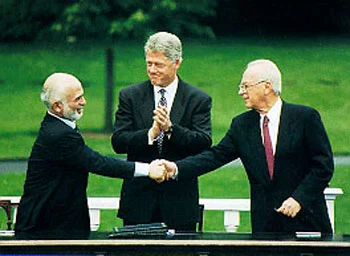
Hussein, Clinton and Rabin in Washington, 25 July 1994, ahead of the October peace treaty
Hussein, Clinton and Rabin in Washington, 25 July 1994, ahead of the October peace treaty · White House

In one sentence

To turn decades of secret contacts into open peace: an agreed border, shared water and full relations.

The challenge

Israel and Jordan share their longest border, and their leaders had met in secret for many years. Jordan needed water, an agreed border and recognition of its role in Jerusalem; Israel wanted a quiet eastern border and a neighbour that was not part of a hostile alliance.

The way opened after the Oslo agreement, and the Washington Declaration ended the state of belligerency in July 1994. The negotiators included Elyakim Rubinstein, Efraim Halevy and Shimon Peres on the Israeli side, and Fayez Tarawneh and Prince Hassan on the Jordanian side1.

The road there

  1. The Washington Declaration ends the state of belligerency.
  2. The treaty is initialled in Amman1.
  3. The Knesset approves: 105 in favour, 3 against, 6 abstentions2.
  4. The treaty is signed at the Arava crossing3.
  5. Jordan's parliament ratifies: 55 in favour, 23 against4.
  6. The instruments of ratification are exchanged at Beit Gabriel on the Sea of Galilee1.
  7. The special regime at Naharayim/Baqura and Tzofar/Al-Ghamr ends, and Jordan resumes full control of both areas5.

The people

Witnessed
Bill Clinton

What was agreed

  • The border follows the Mandate-era boundary line, with minor adjustments, and without prejudice to the status of territories that came under Israeli military government control in 196736.
  • Security: no use of force or threats, no joining hostile alliances, and preventing terrorism from either side's territory3.
  • Water: the waters of the Yarmouk and the Jordan are shared in fixed seasonal quantities, and the parties cooperate to find Jordan an additional 50 million cubic metres a year of drinking-quality water3.
  • Jerusalem: Israel respects Jordan's present special role in the Muslim holy shrines, and will give high priority to this historic role in the permanent-status talks3.
  • Refugees and displaced persons: to be dealt with in multilateral frameworks, including a committee with Egypt and the Palestinians, and in the permanent-status negotiations3.
  • Naharayim/Baqura and Tzofar/Al-Ghamr: Jordanian sovereignty, with Israeli private land-use rights for 25 years, renewed automatically unless one year's notice is given7.
  • Full diplomatic relations and an exchange of ambassadors within a month of ratification3.

Read the document

The geography

100%
Schematic map of Israel and its neighbours with line typesISRAELJORDANWest BankGolan HeightsJerusalemTel AvivGazaRamallahAmmanEilat · Aqaba · TabaNaharayim / Baqura

Choose a country on the map or in the list. Use + and − to zoom. On touch screens, enable gestures to drag and pinch; scroll the page outside the map. Keyboard: arrows to pan, + and − to zoom, Home to reset.

Layers · Legend
  • International boundary agreed in a peace treaty
  • Treaty line with Jordan, “without prejudice to the status” of the territory beyond it
  • 1949 armistice line (“Green Line”) — not an agreed final border
  • “Blue Line” — UN line of withdrawal (2000), not a border
  • Ceasefire / disengagement line with Syria (1974)
  • Other international boundary
  • West Bank and Gaza Strip: permanent status not agreed
  • Golan Heights: held by Israel since 1967; annexation not recognised by the UN
  • UN area of separation (UNDOF)

Classification follows the original research as of 7 Oct 2026. This schematic map is not a legal boundary map or a live update.

  • International boundary agreed in a peace treaty
  • Treaty line with Jordan, “without prejudice to the status” of the territory beyond it
  • 1949 armistice line (“Green Line”) — not an agreed final border
  • “Blue Line” — UN line of withdrawal (2000), not a border
  • Ceasefire / disengagement line with Syria (1974)
  • Other international boundary
  • West Bank and Gaza Strip: permanent status not agreed
  • Golan Heights: held by Israel since 1967; annexation not recognised by the UN
  • UN area of separation (UNDOF)

Schematic map. Lines are approximate and are not a legal determination. Data: Natural Earth (public domain), 1:10m scale; line classification and place names by this site. Lines as of October 2026. Peace map

The hard decisions

  • Israel recognised Jordanian sovereignty over land that Israeli farmers had worked, and settled for use rights for a limited period7.
  • In Jordan's parliament, 23 deputies voted against the treaty4, and opposition to normalisation with Israel continued in Jordan afterwards.
  • The core issues between Israel and the Palestinians – Jerusalem and the refugees – were explicitly left to other negotiations3.

What was carried out

  • Border crossings and embassies opened, and the two countries exchanged ambassadors8. According to reports, Israel transfers about 50 million cubic metres of water a year to Jordan under the treaty910.
  • On 26 September 2016 a contract was signed to supply Israeli gas to Jordan's national electricity company: 45 billion cubic metres over 15 years, for about 10 billion dollars11. The gas began to flow in January 202012.

What was not

  • The Prosperity declaration of intent (Israel, Jordan and the United Arab Emirates, 22 November 2021) – Jordanian solar power for Israel and desalinated water for Jordan – never became an agreement13. On 16 November 2023 Jordan's foreign minister said Jordan would not sign it14.
  • The broad civilian cooperation the treaty outlined developed only in part, and ambassadors are absent on both sides8.

What changed in real life

  • There has been no war between the two countries since 1994, and they have an agreed border3.
  • Israel supplies Jordan with water and natural gas1011.

What remains open

  • The special regime at Naharayim/Baqura and Tzofar/Al-Ghamr was not renewed: King Abdullah II gave notice in October 2018, and it expired on 10 November 20195. This was a step the treaty itself allowed7.
  • In 2021 it was agreed that Israel would sell Jordan an additional 50 million cubic metres a year. According to a July 2026 report, the arrangement lapsed in November 2025 and was not renewed: Jordan asked for a five-year renewal, and an Israeli official said Israel supplies the water required under the treaty and has no obligation to provide additional quantities10.
  • The Temple Mount / Haram al-Sharif remains a constant point of friction; in September 2026 Jordan protested over visits to the site15.

Photos, videos and quotes

This is peace with dignity. This is peace with commitment.

King Hussein of Jordan · Signing ceremony of the Israel–Jordan peace treaty, Arava/Araba crossing, 26 October 1994
Official White House transcript, in English. The Hebrew and Arabic translations are the site's own, not official texts.
Quote source: The White House, Office of the Press Secretary (Clinton White House archive, US National Archives)

You died as a soldier for peace and I believe it is time for all of us to come out openly and to speak of peace.

King Hussein of Jordan · Eulogy at Yitzhak Rabin's funeral, Mount Herzl, Jerusalem, 6 November 1995
English text attributed to Israel's Ministry of Foreign Affairs, as reproduced by the Jewish Virtual Library; the ministry's own page was not located. The translations are the site's own, not official texts.
Quote source: Jewish Virtual Library, reproducing Israel Ministry of Foreign Affairs

6 November 1995 Iconic moment

Israel - Rabin's Funeral & Eulogies

Rabin's funeral and the eulogies, Jerusalem, 6 November 1995 – archive footage. The description rests on the video title; which eulogies it contains was not verified.

At the funeral King Hussein eulogised Rabin as a brother, colleague and friend – only a year after the two signed the peace treaty. President Mubarak, President Clinton and Rabin's granddaughter Noa Ben Artzi also spoke.

AP Archive · Opens on the source site in a new tab

26 July 1994 Iconic momentNot from an official or archival channel

King Hussein and Yitzhak Rabin Address US Congress July 1994

King Hussein and Prime Minister Rabin address a joint meeting of the US Congress, Washington, 26 July 1994. Uploaded by a private channel, not an official one.

A day after signing the Washington Declaration, which ended the state of belligerency between Israel and Jordan, the two stood side by side in Congress. Rabin described himself as a soldier in the army of peace; three months later the peace treaty was signed.

reds6476 · Opens on the source site in a new tab

26 October 1994 Iconic moment

"שלום בין חיילים, ביו אנשים": חתימת הסכם השלום בין ישראל לירדן | היום לפני

Signing of the Israel–Jordan peace treaty at the Arava/Araba crossing, 26 October 1994 – a retrospective report by Kan News, Israel's public broadcaster, in Hebrew

Israel's second peace treaty with an Arab state was signed in the desert, on the border line itself, with King Hussein, Rabin and President Clinton present. It settled the border and water sharing and remains in force today.

כאן | חדשות - תאגיד השידור הישראלי · Opens on the source site in a new tab

Local photographs with credits and links to sources and licences. Where a usable image was unavailable, an archive link remains.

Hussein, Clinton and Rabin in Washington, 25 July 1994, ahead of the October peace treaty

25 July 1994

Hussein, Clinton and Rabin in Washington, 25 July 1994, ahead of the October peace treaty

White House

Licence

Public domain — U.S. government photograph; source file contains provenance

See the photo in the archive

Sources

  1. Official archive Israel State Archives
    Negotiating peace between Israel and Jordan, September 1993 – November 1994
  2. Official archive Israel Ministry of Foreign Affairs (via Jewish Virtual Library) · 25 October 1994
    Statement in the Knesset by Prime Minister Rabin on the Israel-Jordan Peace Treaty, 25 October 1994
  3. Primary United Nations (UNISPAL) · 26 October 1994
    Treaty of Peace between the State of Israel and the Hashemite Kingdom of Jordan, 26 October 1994
  4. Research Institute for Palestine Studies – Chronology · 6 November 1994
    Chronology entry, 6 November 1994: Jordanian parliament ratifies the peace treaty
  5. Press The Times of Israel · 10 November 2019
    Liveblog, 10 November 2019
  6. Reference נשים עושות שלום
    הסכמים מדיניים עיקריים במזרח התיכון
  7. Primary Avalon Project, Yale Law School · 26 October 1994
    Treaty of Peace between Israel and Jordan – Annex I (boundary; Naharayim/Baqura and Zofar/Al-Ghamr areas)
  8. Press Ynetnews · 7 July 2026
    Report on Israel–Jordan diplomatic relations and the ambassadors' posts, 7 July 2026
  9. Primary United Nations (UNISPAL) · November 1995
    Developments / Peace process review: October 1994 – October 1995
  10. Press Middle East Eye · 8 July 2026
    'No obligation to provide': Israel withholds water from Jordan
  11. Press Globes · 26 September 2016
    Jordan signs $10b Leviathan gas deal
  12. Press Globes · January 2020
    Leviathan gas begins flowing to Jordan not opened from the build environment
  13. Primary UAE Ministry of Foreign Affairs · 22 November 2021
    UAE, Jordan and Israel declaration of intent on energy and water collaboration, 22 November 2021
  14. Press Al Jazeera · 16 November 2023
    Jordan says it will not sign energy and water exchange deal with Israel
  15. Press The Times of Israel · September 2026
    Israel-Jordan relations (topic page)

Further reading