Room for Peace

Israel and Jordan ·

The Washington Declaration

A joint declaration that ended the state of belligerency between Israel and Jordan – not the peace treaty itself, which was signed three months later.

In 30 seconds

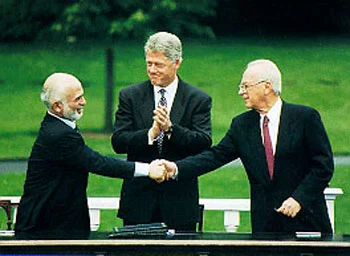
On 25 July 1994 King Hussein and Prime Minister Yitzhak Rabin signed a declaration at the White House ending the state of belligerency between their countries, with President Clinton signing as witness3. It included first practical steps and led to a peace treaty within three months.

Where it stands today

The declaration did its job: its principles were carried into the Israel–Jordan Peace Treaty of 26 October 1994, which replaced it4. It is therefore classed here as superseded, although the steps it set out were carried out.

Hussein, Clinton and Rabin in Washington, 25 July 1994, ahead of the October peace treaty
Hussein, Clinton and Rabin in Washington, 25 July 1994, ahead of the October peace treaty · White House

In one sentence

To declare publicly the end of the state of belligerency and open the way to a full peace treaty.

The challenge

Israel and Jordan had held secret contacts for many years, but a state of belligerency formally existed between them. Once Israel and the PLO signed the Declaration of Principles in September 1993, Jordan could move forward openly. The day after that signing, the heads of the delegations, Elyakim Rubinstein and Fayez Tarawneh, signed a common agenda for the negotiations1.

The road there

  1. The Common Agenda is signed in Washington1.
  2. Secret meeting between Rabin and Hussein in Aqaba2.
  3. Peres meets Hussein in Amman2.
  4. Secret meeting between Rabin and Hussein in London2.
  5. The first open bilateral talks begin at Ein Evrona in the Arava2.
  6. The declaration is signed at the White House3.
  7. The Arava border crossing opens2.

The people

Witnessed
Bill Clinton

What was agreed

  • The state of belligerency between Israel and Jordan has ended3.
  • Israel respects Jordan's special role in the Muslim holy shrines in Jerusalem and will give it high priority in the permanent-status talks3.
  • Direct telephone lines and a link between the electricity grids3.
  • Two new border crossings: between Aqaba and Eilat, and in the north3.
  • Cooperation on tourism, an air corridor, and cooperation between the police forces3.
  • Action to end economic boycotts3.

Read the document

The geography

100%
Schematic map of Israel and its neighbours with line typesISRAELJORDANWest BankGolan HeightsJerusalemTel AvivGazaRamallahAmmanEilat · Aqaba · TabaNaharayim / Baqura

Choose a country on the map or in the list. Use + and − to zoom. On touch screens, enable gestures to drag and pinch; scroll the page outside the map. Keyboard: arrows to pan, + and − to zoom, Home to reset.

Layers · Legend
  • International boundary agreed in a peace treaty
  • Treaty line with Jordan, “without prejudice to the status” of the territory beyond it
  • 1949 armistice line (“Green Line”) — not an agreed final border
  • “Blue Line” — UN line of withdrawal (2000), not a border
  • Ceasefire / disengagement line with Syria (1974)
  • Other international boundary
  • West Bank and Gaza Strip: permanent status not agreed
  • Golan Heights: held by Israel since 1967; annexation not recognised by the UN
  • UN area of separation (UNDOF)

Classification follows the original research as of 7 Oct 2026. This schematic map is not a legal boundary map or a live update.

  • International boundary agreed in a peace treaty
  • Treaty line with Jordan, “without prejudice to the status” of the territory beyond it
  • 1949 armistice line (“Green Line”) — not an agreed final border
  • “Blue Line” — UN line of withdrawal (2000), not a border
  • Ceasefire / disengagement line with Syria (1974)
  • Other international boundary
  • West Bank and Gaza Strip: permanent status not agreed
  • Golan Heights: held by Israel since 1967; annexation not recognised by the UN
  • UN area of separation (UNDOF)

Schematic map. Lines are approximate and are not a legal determination. Data: Natural Earth (public domain), 1:10m scale; line classification and place names by this site. Lines as of October 2026. Peace map

The hard decisions

  • Hussein took a public step before a full peace treaty was reached and before the border and water questions were settled.
  • Recognising the Jordanian role in Jerusalem touched a question that the Palestinians also regard as a core issue, and that was left to the permanent-status talks3.

What was carried out

  • The Arava crossing opened two weeks after the signing2.
  • The negotiations were completed and the peace treaty was signed on 26 October 19944.

What was not

—

What remains open

  • The clause on Jerusalem passed into the peace treaty4 and is still a point of friction between the two countries.

Photos, videos and quotes

Yitzhak Rabin, soldier in the Israel Defense Forces, and a soldier in the army for peace

Yitzhak Rabin · US Congress, Washington, 26 July 1994. An excerpt from the sentence in which Rabin introduces himself by his military number.
A short excerpt from the Rabin Center’s English transcript, not the full sentence. A Hebrew text is also available from the Center.
Quote source: The Yitzhak Rabin Center

26 July 1994 Iconic momentNot from an official or archival channel

King Hussein and Yitzhak Rabin Address US Congress July 1994

King Hussein and Prime Minister Rabin address a joint meeting of the US Congress, Washington, 26 July 1994. Uploaded by a private channel, not an official one.

A day after signing the Washington Declaration, which ended the state of belligerency between Israel and Jordan, the two stood side by side in Congress. Rabin described himself as a soldier in the army of peace; three months later the peace treaty was signed.

reds6476 · Opens on the source site in a new tab

Local photographs with credits and links to sources and licences. Where a usable image was unavailable, an archive link remains.

Hussein, Clinton and Rabin in Washington, 25 July 1994, ahead of the October peace treaty

25 July 1994

Hussein, Clinton and Rabin in Washington, 25 July 1994, ahead of the October peace treaty

White House

Licence

Public domain — U.S. government photograph; source file contains provenance

See the photo in the archive

Sources

  1. Official archive Israel State Archives
    Negotiating peace between Israel and Jordan, September 1993 – November 1994
  2. Official archive Israel State Archives
    Timeline – peace between Israel and Jordan
  3. Primary United Nations (UNISPAL) · 25 July 1994
    The Washington Declaration: Israel – Jordan – The United States, 25 July 1994
  4. Primary United Nations (UNISPAL) · 26 October 1994
    Treaty of Peace between the State of Israel and the Hashemite Kingdom of Jordan, 26 October 1994

Further reading