Room for Peace

Israel and the Palestinians ·

The Kerry talks

US-mediated permanent-status negotiations that ended without an agreement and without an agreed document.

In 30 seconds

In 2013 US Secretary of State John Kerry led a nine-month round of talks between Israel and the Palestinians. Israel undertook to release long-serving prisoners and the Palestinians to hold back from moves at the UN. In April 2014 the talks collapsed, and each side blames the other.

Where it stands today

The talks were suspended on 24 April 2014, days before their target end date, and ended without an agreement1. They were the last round of direct permanent-status negotiations documented on this site.

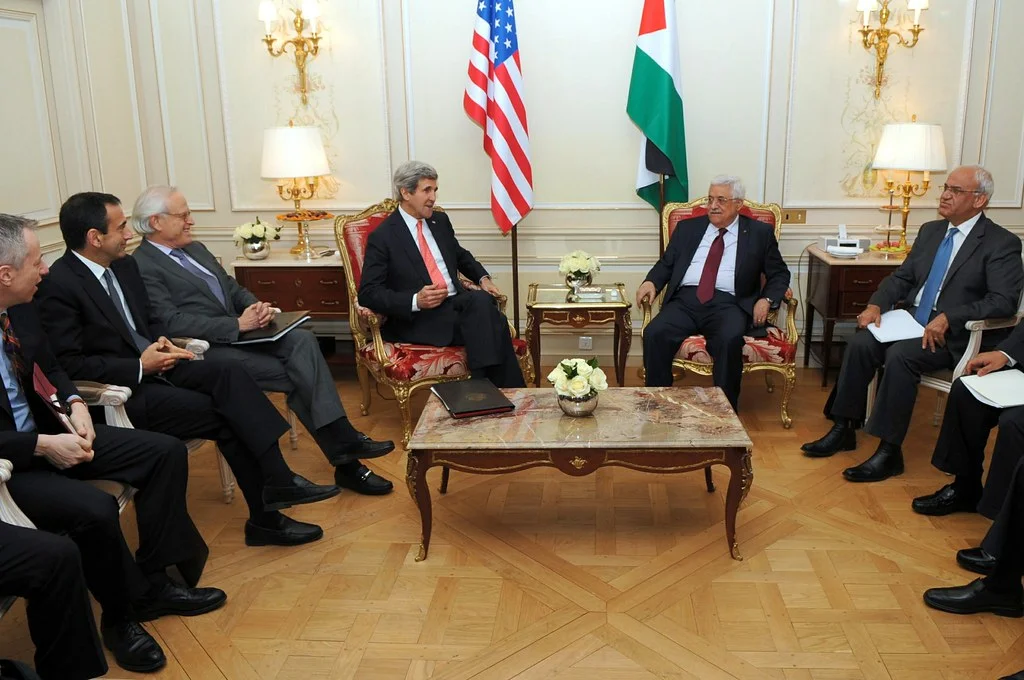
Mahmoud Abbas seated with John Kerry before a meeting in Paris, February 2014
Mahmoud Abbas seated with John Kerry before a meeting in Paris, February 2014 · State Department photo / Public Domain

In one sentence

To reach a permanent agreement within nine months, or at least an agreed framework for continuing.

The challenge

Since the Olmert–Abbas talks of 2008 there had been no sustained negotiation on permanent status. The framework for the talks set nine months, until 29 April 20141.

To make the talks possible a deal was set: Israel would release 104 long-serving Palestinian prisoners in four tranches, and the Palestinians would meanwhile refrain from unilateral moves at the UN1.

The road there

  1. Talks open, mediated by John Kerry1.
  2. Israel does not carry out the fourth prisoner release on time1.
  3. Mahmoud Abbas announces a reconciliation agreement between Fatah and Hamas1.
  4. Israel suspends the talks1.

The people

Mediated
John Kerry

What was discussed

  • A nine-month timetable for negotiating the core issues1.
  • Release of 104 long-serving prisoners in four tranches, in return for the Palestinians refraining from turning to UN bodies1.
  • The United States drew up a framework document on the core issues; the parties did not adopt it1.

The geography

100%
Schematic map of Israel and its neighbours with line typesWest BankGaza StripJerusalemTel AvivGazaRamallahAmmanRafahNaharayim / Baqura

Choose a country on the map or in the list. Use + and − to zoom. On touch screens, enable gestures to drag and pinch; scroll the page outside the map. Keyboard: arrows to pan, + and − to zoom, Home to reset.

Layers · Legend
  • International boundary agreed in a peace treaty
  • Treaty line with Jordan, “without prejudice to the status” of the territory beyond it
  • 1949 armistice line (“Green Line”) — not an agreed final border
  • “Blue Line” — UN line of withdrawal (2000), not a border
  • Ceasefire / disengagement line with Syria (1974)
  • Other international boundary
  • West Bank and Gaza Strip: permanent status not agreed
  • Golan Heights: held by Israel since 1967; annexation not recognised by the UN
  • UN area of separation (UNDOF)

Classification follows the original research as of 7 Oct 2026. This schematic map is not a legal boundary map or a live update.

  • International boundary agreed in a peace treaty
  • Treaty line with Jordan, “without prejudice to the status” of the territory beyond it
  • 1949 armistice line (“Green Line”) — not an agreed final border
  • “Blue Line” — UN line of withdrawal (2000), not a border
  • Ceasefire / disengagement line with Syria (1974)
  • Other international boundary
  • West Bank and Gaza Strip: permanent status not agreed
  • Golan Heights: held by Israel since 1967; annexation not recognised by the UN
  • UN area of separation (UNDOF)

Schematic map. Lines are approximate and are not a legal determination. Data: Natural Earth (public domain), 1:10m scale; line classification and place names by this site. Lines as of October 2026. Peace map

The hard decisions

  • According to The Christian Science Monitor, in March 2014 Abbas rejected three principles in the US framework document: recognition of Israel as a Jewish state, giving up the refugees' right of return, and declaring an end to the conflict1.
  • According to Peace Now figures, during the talks Israel advanced plans and tenders for at least 13,850 housing units in East Jerusalem and the West Bank1.

Where accounts differ

According to The Israeli government
The talks collapsed because of unilateral Palestinian steps: joining the international conventions and the reconciliation agreement with Hamas, which Israel saw as a choice to side with terrorism1.
According to The Palestinian leadership
The talks collapsed because settlement construction continued during them and because the fourth prisoner release was not carried out1.

What was carried out

  • Three releases were carried out, freeing at least 78 prisoners; the Palestinians refrained from moves at the UN until March 20141.

What was not

  • The fourth release was not carried out; the Palestinian Authority joined 15 international conventions; no agreement or agreed framework was reached1.

What remains open

  • The experience showed how vulnerable negotiations are to what each side does outside them — settlement construction, turning to international bodies, internal Palestinian agreements — even with a determined mediator1.

Photos, videos and quotes

Local photographs with credits and links to sources and licences. Where a usable image was unavailable, an archive link remains.

Mahmoud Abbas seated with John Kerry before a meeting in Paris, February 2014

19 February 2014

Mahmoud Abbas seated with John Kerry before a meeting in Paris, February 2014

State Department photo / Public Domain

Licence

United States government work; caption: [State Department photo/ Public Domain]
See the photo in the archive
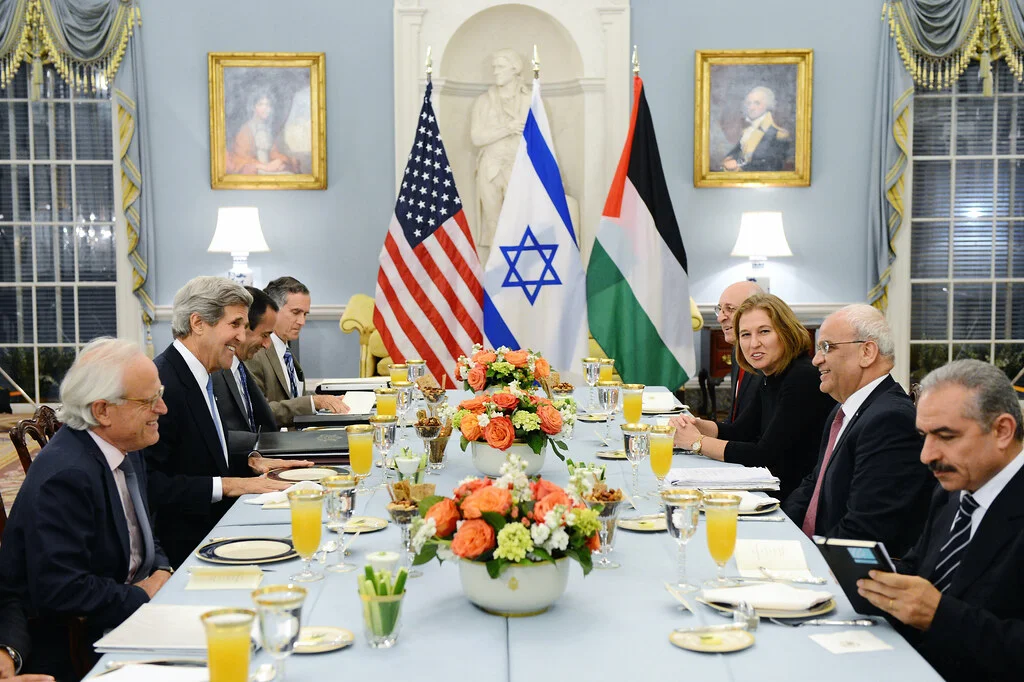
Tzipi Livni and Saeb Erekat with John Kerry at the State Department at the start of the 2013 talks

29 July 2013

Tzipi Livni and Saeb Erekat with John Kerry at the State Department at the start of the 2013 talks

State Department photo / Public Domain

Licence

United States government work; caption: [State Department photo/ Public Domain]

See the photo in the archive

Sources

  1. Press The Christian Science Monitor · 29 April 2014
    How Secretary Kerry's bid for peace ended up in tatters

Further reading