Room for Peace

Israel and EgyptWashington, DC

Egypt–Israel Peace Treaty

Peace treatyIn force, relations strained

A full peace treaty between two states, the first between Israel and an Arab state. It does not settle the Palestinian question.

In 30 seconds

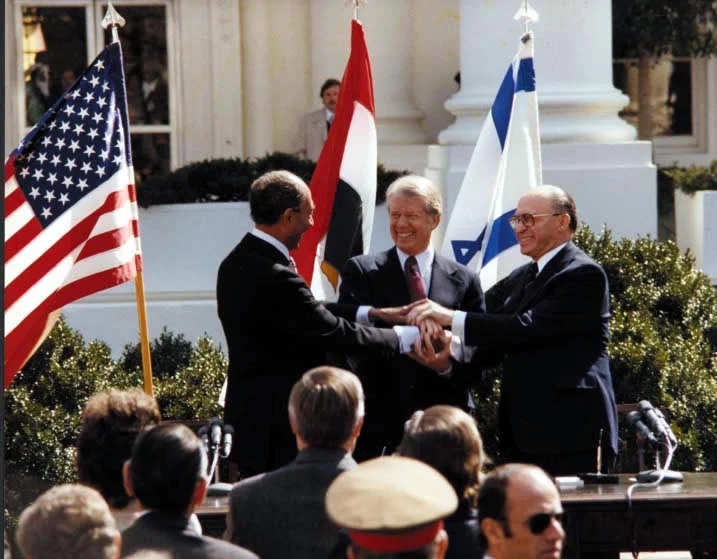
On 26 March 1979 Sadat and Begin signed a peace treaty in Washington, with President Carter signing as witness.9 Israel left all of Sinai; Egypt recognised Israel and opened full relations. The two countries have not fought since, but the peace has stayed cool.

Where it stands today

As of August 2026, according to the Carnegie Endowment, security coordination still works and a new gas deal has been ratified, despite deep tensions.15 Political relations are at a low point: according to reports from May 2025 and January 2026, Egypt has no ambassador in Tel Aviv and is holding back the accreditation of Israel's ambassador-designate.2627

Sadat, Carter and Begin at the peace treaty signing, 26 March 1979
Sadat, Carter and Begin at the peace treaty signing, 26 March 1979 Jimmy Carter Library / CIA archival release

In one sentence

To end the state of war between Israel and Egypt: all of Sinai in exchange for full peace.

The challenge

Egypt wanted all of Sinai back, which Israel had captured in 1967. Israel wanted the largest and strongest Arab state out of the cycle of war. The Camp David Accords set the principle; it took six more months to turn it into a treaty. The treaty was the last stop on a road that began under the Meir and Rabin governments and ran through Sadat's visit to Jerusalem.

The road there

  1. The first disengagement agreement in Sinai is signed, under Golda Meir's government.1
  2. The interim agreement is signed in Geneva, under Yitzhak Rabin's government.2
  3. Sadat lands in Israel and the next day speaks in the Knesset.3
  4. The Camp David Accords are signed.
  5. Carter travels to Israel and Egypt. The last disputes are settled, partly in talks between US Secretary of State Vance and Foreign Minister Dayan.4
  6. The treaty is signed in Washington.5
  7. The first ambassadors take up their posts: Eliahu Ben-Elissar for Israel and Saad Mortada for Egypt.6
  8. Israel completes its withdrawal and Sinai returns to Egyptian sovereignty.7
  9. Taba is handed to Egypt after an arbitration ruling.8

The people

Negotiated
Moshe Dayan
Witnessed
Jimmy Carter

What was agreed

  • The state of war ends. Peace begins when the instruments of ratification are exchanged.9
  • Israel takes all its forces and civilians out of Sinai within three years.9
  • The permanent border is the international boundary between Egypt and Mandatory Palestine, leaving the status of the Gaza Strip open.9
  • Full recognition, with diplomatic, economic and cultural relations.9
  • Limited-force zones on both sides of the border, with an international force and observers.9
  • Israeli ships may pass through the Suez Canal; the Strait of Tiran and the Gulf of Aqaba are international waterways.9

Read the document

The geography

100%
Schematic map of Israel and its neighbours with line typesGulf of AqabaGulf of SuezEGYPTSinaiISRAELGaza StripJerusalemGazaSharm el-SheikhEilat · Aqaba · TabaRafahSuez

Choose a country on the map or in the list. Use + and − to zoom. On touch screens, enable gestures to drag and pinch; scroll the page outside the map. Keyboard: arrows to pan, + and − to zoom, Home to reset.

Layers · Legend
  • International boundary agreed in a peace treaty
  • Treaty line with Jordan, “without prejudice to the status” of the territory beyond it
  • 1949 armistice line (“Green Line”) — not an agreed final border
  • “Blue Line” — UN line of withdrawal (2000), not a border
  • Ceasefire / disengagement line with Syria (1974)
  • Other international boundary
  • West Bank and Gaza Strip: permanent status not agreed
  • Golan Heights: held by Israel since 1967; annexation not recognised by the UN
  • UN area of separation (UNDOF)

Classification follows the original research as of 7 Oct 2026. This schematic map is not a legal boundary map or a live update.

  • International boundary agreed in a peace treaty
  • Treaty line with Jordan, “without prejudice to the status” of the territory beyond it
  • 1949 armistice line (“Green Line”) — not an agreed final border
  • “Blue Line” — UN line of withdrawal (2000), not a border
  • Ceasefire / disengagement line with Syria (1974)
  • Other international boundary
  • West Bank and Gaza Strip: permanent status not agreed
  • Golan Heights: held by Israel since 1967; annexation not recognised by the UN
  • UN area of separation (UNDOF)

Schematic map. Lines are approximate and are not a legal determination. Data: Natural Earth (public domain), 1:10m scale; line classification and place names by this site. Lines as of October 2026. Peace map

The hard decisions

  • Israel gave up all of Sinai, including airfields10 and every settlement it had built there. According to the Jewish Virtual Library there were 14, the largest of them Yamit.11 In the Knesset, 18 members voted against the treaty.12
  • The Arab League suspended Egypt and moved its headquarters from Cairo to Tunis. Egypt was readmitted in 1989.13
  • On 6 October 1981, members of the Egyptian Islamic Jihad organisation led by Lieutenant Khalid al-Islambouli assassinated Sadat at a military parade in Cairo.14 They had several motives: the demand for Islamic law, a law widening women's rights, the Jerusalem visit and Camp David, and a wave of arrests of about 1,500 opponents in September 1981.14
  • His successor, Hosni Mubarak, kept the treaty.

Where accounts differ

According to Egypt
Israel's military presence in the Philadelphi corridor, along the Gaza–Egypt border, violates the treaty's security annex.15
According to Israel
The deployment of Egyptian forces in Sinai near the border exceeds what the treaty allows and threatens its security.15

What was carried out

  • Israel removed the residents of Yamit by force on 23 April 1982, with no one killed, and most of its buildings were demolished.11 Two days later the withdrawal was complete.7
  • The UN could not provide a peacekeeping force, so in August 1981 the parties created the Multinational Force and Observers (MFO). It still monitors the security arrangements and shipping in the Strait of Tiran.16
  • An arbitration panel ruled on Taba on 29 September 1988,17 and the area was handed to Egypt in March 1989.8
  • In November 2021 the Egyptian army announced an agreed change to the security arrangements, allowing more border guards in the Rafah area.18

What was not

  • A broad, warm peace between the two societies did not develop. According to a Carnegie Endowment analysis, the relationship runs in separate boxes: cooperation on security and energy, alongside political tension.15

What changed in real life

  • No war has broken out between Israel and Egypt since 1973.
  • Since December 2004, Egyptian goods with an Israeli component have entered the United States duty-free, under the Qualifying Industrial Zones (QIZ) protocol.19
  • Since January 2020 Israel has exported natural gas to Egypt.20 In August 2025 the Leviathan partners signed a deal worth about 35 billion dollars, running to 2040,21 and Israel's government approved the export on 17 December 2025.22 According to the Carnegie Endowment, Israeli gas covers about 15 to 20 percent of Egypt's daily use.15

What remains open

  • Since the war in Gaza, relations have been very tense. Egypt treats any move of Gaza's residents into Sinai as a red line,23 and said so again in September 2026.24
  • On 7 October 2026, remarks about Sinai by the Israeli minister Bezalel Smotrich drew sharp responses in the Egyptian media.25

Photos, videos and quotes

Menachem Begin

No more war, no more bloodshed, no more bereavement.

Signing ceremony of the Egypt–Israel peace treaty, the White House, Washington, 26 March 1979

Source and status of the wording

Official US transcript (Public Papers of the Presidents), in English. These are the closing words of a longer sentence in Begin's remarks. The wording is singular – "war", not "wars".

Quote source: The American Presidency Project, UC Santa Barbara (Public Papers of the Presidents)

Menachem Begin

Yes, there are difficulties in peace, there are. There are pains in peace, there are. There are sacrifices for the sake of peace, there are. All of them are preferable to the victims of war!

Knesset plenum, Jerusalem, 2 March 1982: the Prime Minister's reply to a no-confidence motion by the Tehiya faction, which demanded a halt to the withdrawal from Sinai, in the weeks before the withdrawal under the peace treaty with Egypt was completed.

Source and status of the wording

Wording in the source: כן, יש קשיים בשלום, יש. יש מכאובים בשלום, יש. יש קורבנות למען השלום, יש. כולם עדיפים מקורבנות המלחמה!

The wording as quoted in Yedioth Ahronoth (ynet, 2017). The speech is catalogued in the Begin Heritage Center's database of Begin's writings (65th sitting of the Tenth Knesset). In public memory the sentence is sometimes shortened to "the difficulties of peace are better than the agonies of war". The Hebrew uses one word for both "sacrifices" and "victims".

Quote source: Yedioth Ahronoth / ynet (Yehuda Nuriel), quoting the Knesset speech of 2 March 1982

Begin's speech at the Egypt–Israel treaty signing

· Begin Center

At the ceremony sealing the first peace treaty between Israel and an Arab state, Begin declared an end to war, bloodshed and bereavement. Under the treaty Israel withdrew from all of Sinai, and the peace with Egypt has held ever since.

Great Knesset moments: Sadat's visit and peace with Egypt

· The Knesset

The Knesset was the stage of the historic moment: Sadat's speech, Begin's reply, then the debates and votes on the agreements.

President Carter addresses the Knesset, March 1979

· AP Archive

Carter flew between Cairo and Jerusalem to close the last gaps in the treaty text. Two weeks later it was signed in Washington.

Carter's trip to Egypt and Israel, March 1979: Carter Library

· Jimmy Carter Presidential Library

This trip rescued the negotiations when they looked stuck. At its end Carter announced both sides had accepted the final proposals.

The Egypt treaty signing on Israeli radio

· החדשות הישנות

This is how listeners in Israel heard Begin, Sadat and Carter sign the treaty on the White House lawn.

El Arish returns to Egypt, May 1979

· AP Archive

The El Arish handover was the first stage of the Sinai withdrawal under the treaty, only two months after the signing.

Reagan and three former presidents before Sadat's funeral

· Reagan Library

Sadat was assassinated by extremists at a military parade in Cairo on 6 October 1981. Nixon, Ford and Carter flew to the funeral together, and Begin attended too.

The road to Sinai's return in 1982: Egyptian TV

· القناة الأولى المصرية

On 25 April 1982 Israel completed its withdrawal from Sinai. In Egypt the day is marked every year as Sinai Liberation Day.

The evacuation of Yamit, 1982

· Meima

The evacuation was a painful price of peace: residents lost their homes and the debate in Israel was fierce. Begin's government kept its commitment.

Egypt regains Taba, 1989

· ذاكرة ماسبيرو

The dispute over the small coastal strip was settled by international arbitration in 1988: a border quarrel resolved by peaceful means.

Signing of the Egypt–Israel peace treaty – AP clip

· AP Archive

Signing of the Egypt–Israel peace treaty, Washington, 26 March 1979 – short archive clip

Sources

You do not have to agree with us. That is what the sources are for: open them, compare and check for yourself.

  1. Primary United Nations (UNISPAL) · 18 January 1974
    Letter dated 18 January 1974 from the Secretary-General addressed to the President of the Security Council (Egyptian-Israeli Agreement on Disengagement of Forces)
  2. Primary United Nations (UNISPAL) · 1975
    Yearbook of the United Nations 1975 (excerpts)
  3. Official archive U.S. Department of State, Office of the Historian
    Foreign Relations of the United States, 1977–1980, vol. VIII, Arab-Israeli Dispute, document 152 (editorial note on Sadat's visit to Jerusalem)
  4. Official archive U.S. Department of State, Office of the Historian
    Foreign Relations of the United States, 1977–1980, vol. IX, Arab-Israeli Dispute, document 207
  5. Primary United Nations Treaty Series · 26 March 1979
    Treaty of Peace between the Arab Republic of Egypt and the State of Israel (vol. 1136, no. 17813)
  6. Reference World Jewish Congress
    This week in Jewish history: Egypt and Israel usher in new era of peace in first ambassador exchange
  7. Official archive Multinational Force and Observers
    Deadline Met: Mission Begins
  8. Press The Christian Science Monitor · 16 March 1989
    Report on the handover of Taba to Egypt, 16 March 1989
  9. Primary Avalon Project, Yale Law School · 26 March 1979
    Peace Treaty between Israel and Egypt, March 26, 1979
  10. Official archive U.S. Department of State, Office of the Historian
    Foreign Relations of the United States, 1977–1980, vol. IX, Arab-Israeli Dispute, document 57 (editorial note)
  11. Reference Jewish Virtual Library
    The Yamit Evacuation
  12. Official archive Israel Ministry of Foreign Affairs (via Jewish Virtual Library) · March 1979
    Prime Minister Begin: Summary of Debate on Treaty with Egypt, March 1979
  13. Press CNN (via KTVZ) · 7 March 2024
    Arab League Fast Facts
  14. Research James Martin Center for Nonproliferation Studies
    Al-Jihad al-Islami (Egyptian Islamic Jihad) – profile
  15. Research Carnegie Endowment for International Peace (Sada) · 31 August 2026
    Gas and Peace: Can Energy Trade Contain Egypt-Israel Conflict?
  16. Official archive Multinational Force and Observers
    MFO – Origins
  17. Primary United Nations, Reports of International Arbitral Awards, vol. XX · 29 September 1988
    Case concerning the location of boundary markers in Taba between Egypt and Israel, decision of 29 September 1988
  18. Press Al-Monitor · November 2021
    Israel, Egypt increase military presence along Egypt's Rafah border
  19. Primary United Nations (UNISPAL) · 14 December 2004
    Egypt–Israel–United States Qualifying Industrial Zones protocol, 14 December 2004
  20. Press S&P Global Commodity Insights · 15 January 2020
    Israel begins gas exports to Egypt from giant Leviathan field
  21. Press The Times of Israel · 7 August 2025
    In Israel's largest gas deal, Leviathan partners ink $35 billion export deal with Egypt
  22. Research The Washington Institute for Near East Policy · January 2026
    Building on Egypt and Israel's Uneasy Gas Deal
  23. Press Al Majalla · 17 December 2025
    Egypt-Israel ties being tested by concerns over Gaza and Sinai
  24. Press The Times of Israel · 16 September 2026
    Liveblog, 16 September 2026
  25. Press The Jerusalem Post · 7 October 2026
    Egyptian commentators respond to Smotrich's remarks on Sinai
  26. Press Ynetnews · 11 May 2025
    Report on Egypt withholding accreditation of Israel's ambassador-designate
  27. Press The Jewish Chronicle · 7 January 2026
    Egypt is revising its peace agreement with Israel (analysis)
  28. Primary United Nations (UNISPAL) · 30 November 1971
    Report of the Secretary-General on the activities of the Special Representative to the Middle East (S/10403), 30 November 1971
  29. Official archive U.S. Department of State, Office of the Historian
    The 1973 Arab-Israeli War

Further reading